Advertisements
There is a labor crisis of epic proportions in Germany. The economic giant of Europe requires laborers, not only doctors and engineers, but those who make the nation work, warehouse packers, cleaners, delivery drivers, construction assistants, and caregivers. In 2026 the German government predicts that they must receive a net of 400,000 people annually to stabilize the economy and more than 1.44 million positions will remain unfilled.
This is not only statistics. This concerns the opportunity- your opportunity to legally work in Germany, earn in Euros, have a better life and possibly open a door leading to permanent European residency. Whether you are a Nigerian, Indian, Kenyan, Philippine-based or non-EU-based, this step-by-step guide will show you just how to get an unskilled job in Germany with visa sponsorship in 2026.
Learning the Landscape: Why Germany Needs You.
The labor force in Germany is getting old. The Baby Boomer generation is retiring at an alarming rate, leaving massive vacancies in every sector of the economy. Germany has fundamentally altered its immigration policy unlike in many countries where most of the countries only absorb highly educated professionals and they have realized that the economy cannot stabilize without the workers of all levels of skills.
Advertisements
This population fact has compelled the German government to create legal avenues to unskilled laborers- a phenomenon that is not common in advanced economies. The nation has also added new types of visas and extended the already existing ones so as to invite a foreign employee to work in the country in the entry level jobs.
Demand is genuine, urgent and increasing. Companies such as DHL, Amazon, Lidl, Aldi, along with thousands of small and medium-sized German companies are actively recruiting the foreign workforce and ready to sponsor their visas to fill such dire vacancies.
What Do Unskilled Jobs in Germany Mean?
To begin with, we need to straighten the terminology. In German immigration law, unskilled or low-skilled jobs are jobs that do not need formal vocational education (Ausbildung) or a university degree. Nevertheless, it does not imply that these are effortless jobs, which are not significant to the work of the German economy.
Some of the most common types of unskilled jobs are in the field of hospitality and food services like kitchen assistants, dishwashers, waiters, cleaners, and hotel room attendants. The warehouse and logistics jobs such as pickers, packers, fork lifts and delivery drivers are in high demand. Retail jobs such as cashiers, stock replenishers and store assistants are very common. There are seasonal agricultural jobs like picking fruits, farm workers, and livestock care. Laborers and building helpers assist skilled individuals in the construction sites. Some of the manufacturing jobs are assembly line workers and production assistants. Lastly, cleaning and maintenance roles are inclusive of office cleaners, janitors, and facility maintenance employees.
There are no formal qualifications usually needed in these positions other than basic physical fitness, reliability, and more and more, some knowledge of the German language.
Jurisdictional Diversions to Unskilled Labor in Germany: Your Visa Alternatives.
This is where it gets crucial. There are various legal ways of foreigners to be employed in unskilled jobs in Germany, and each of them has its requirements and advantages. It is important to know which path to follow in order to succeed.
The Western Balkans Regulation: The least challenging Entry Door.
Western Balkans Regulation, should you be an Albanian, Bosnian and Herzegovinian, Kosovo, North Macedonian, Montenegro, or Serbian, then the Western Balkans Regulation is one of the few legal avenues to come to Germany in any form of employment, even simple unskilled labor such as construction helper or cleaner, without having to demonstrate professional qualification or German speaking skills.
The number of annual quota has been doubled permanently to 50,000 visas per year. The only condition is that there should be an offer of employment by a German employer that is binding. You enter by either a lottery or appointment at the German embassy in your local country.
Nevertheless, the inside secret is as follows: though proficiency in the German language is not a prerequisite, employers pay much attention to the candidates who either speak at least basic German at A1 or A2 level. It can be the difference between your application being accepted or straight out denied.
And, should you happen to be of one of these six nations, it is your free ticket. Learn simple German as soon as possible and start applying via German job agencies and company websites.
The Opportunity Card (Chancenkarte): The Game-Changer to the Rest of us.
The Opportunity Card was introduced in June 2024 and is currently in full operation as of 2026 and is the most radical immigration reform Germany has had in decades. This is the avenue that opens Germany to the unskilled workers of the world.
It works in the following way: the Opportunity Card is a 12-month job-seeking visa that enables you to come to Germany and find a job without a job offer being offered beforehand. During your job search, you are allowed to work part-time of up to 20 hours in a week and do trial jobs of up to two weeks with any employer.
Basic Requirements:
You should have either two years of vocational training or have a university degree that is accepted in your home country. Note that you need not have your qualification recognised by Germany, although it must be a legitimate qualification where it was gained.
You should have language skills: German A1 level (basic beginner), or English B2 level (upper intermediate). By 2025, you need to demonstrate financial solvency by demonstrating at least EUR13,092 in blocked account over a period of one year, i.e., that is about EUR1,091 per month.
The Points System:
In case you are not already qualified in Germany, then you have to score a minimum of 6 points on the following criteria to be qualified:
Qualification recognition (4 points): In the event that your foreign qualification has been determined to be partially similar to a German qualification.
- Professional experience (2 points): 2 years of professional experience within the past five years.
- Age (3 points below 35; 2 points 35-40; 1 point 40-45): Germany is more comfortable with younger employees who will be of longer service.
- Knowledge of German language (3 points B2; 2 points B1; 1 point A2): The more you know the German language the more chances you have.
- English language proficiency (1 point on C1 level): Advanced English is a helper.
- Qualification in shortage occupation (1 point): In case your training is in an area that Germany is desperate to fill.
- Past German residence (1 point): Have you spent at least six months in Germany in the past five years and legally (lawfully) lived the whole time.
- Spouse qualification (1 point): When you are applying with your partner and your partner meets the requirements of Opportunity Card.
This system is as beautiful as its flexibility. You may be 28 years old (3 points), have 2 years of warehouse experience in home country (2 points), speak German at A2 level (1 point), and with total score of 6 points- you would be classified in the Opportunity Card without any formal education.
After being in Germany with your Opportunity Card, you can work part-time and at the same time, you can be searching full-time jobs. Once you get a full time job, you transfer your Opportunity Card into a regular work permit.
Employment Visa for Under 25s
Germany has special visa, which is provided to individuals below 25 years of age and who already obtained an unskilled job opportunity. This visa usually lasts for a maximum of one year and needs to demonstrate evidence of funds in a blocked account, health insurance, and valid passport as well as the employment contract with your employer in Germany.
This path is best suited in case you are young and have already made contacts with a German employer who can sponsor you directly. The employer has to prove that he or she could not find an eligible candidate in the EU labor market, yet this is not a difficult task in the situation of the existing labor shortages.
Vocational Training (Ausbildung) Programs.
Although not necessarily an unskilled pathway, the pathway is worth mentioning since it is open to individuals who did not have any prior qualifications and results directly into skilled worker.
The Ausbildung system in Germany is a mixture of practical training in the workplace and theoretical classroom training. The usual duration of programs is three years and the monthly salary of the trainees begins around EUR800-EUR1,000 during the first year, which is raised to EUR1,200-EUR1,500 during the third year.
Upon the successful completion of your Ausbildung, you are a qualified skilled employee with assured permanent residence opportunities and monthly wage increases to EUR3,000 and above. Some of the areas that require trainees are in the field of nursing assistants, hotel specialists, construction trades such as bricklaying, as well as other manufacturing apprenticeships.
The benefit is that Ausbildung programs usually require less German language skills to enter (sometimes only A2 level is needed), and companies are usually willing to sponsor the visa and support you during your training.
Best Unskilled jobs in 2026.
Now we want to be specific on the jobs available and what you can earn.
Warehouse and Logistics
As the e-commerce market is growing, firms such as Amazon, DHL, Hermes, and Deutsche Post are constantly seeking people to fill such jobs as picker/packer, forklift operator, and delivery driver with an average salary of EUR14.00-EUR16.00 per hour. The language needs are not necessarily high because English is a language that is rampant in international hubs.
Annual salaries: EUR2,240-EUR2,560 full-time employment (40 hours per week), and an opportunity of overtime, which may considerably increase the salary.
These jobs also entail shift work such as nights and weekends though they come with a good pay that is stable in big and well established firms that handle visa sponsorship effectively.
Hospitality and Gastronomy
The tourism sector in Germany generates a demand of restaurant and hotel employees on a regular basis. Some of the jobs are kitchen assistants, dishwashers, waiters, bartenders, receptionists, and hotel room attendants.
Salaries per hour: EUR9-EUR13 per hour according to the job and place. Salaries: full-time jobs are between EUR1,440 and EUR2,080 monthly.
Although hospitality pays less than logistics, the jobs can come with meals during a shift and occasionally accommodation which will go a long way in saving you on your living expenses. Suggestions can include EUR200-EUR500 every month in tourist destinations or luxurious restaurants.
The language skills of German become more relevant in front of the office jobs whereas back of the house jobs such as kitchen assistants usually only need a basic level of communication skills.
Retail
Large chains such as Lidl, Aldi, Rewe, Edeka and Metro AG actively recruit foreign employees to fill their cashier jobs, stock replenishment jobs, and store assistant jobs.
Hourly wages: EUR9-EUR13 per hour. Monthly salary: EUR1,440 -EUR2,080 full-time.
The retail business has predictable daytime schedules in the majority of cases, but the growing use of Sundays and holidays in supermarkets. Such roles demand additional knowledge of the German language (typically B1 level) because of customer contact.
Seasonal Work and Agriculture.
The agricultural industry of Germany has a lot of seasonal work especially during the harvest of April to October. The positions are fruit pickers, vegetable harvesters, vineyard workers and farm assistants.
Remuneration: This can be on a piece rate basis or not necessarily hourly, i.e. compensation is based on productivity. Average rate: EUR10-EUR15 per hour equivalent, and the highly productive workers are paid more.
Seasonal farming visas are not usually difficult to get compared to permanent jobs and most of the workers come back year after year and establish a relationship with their employers. The accommodation is often offered, either at no cost or at the lowest.
Cleaning and Maintenance
Cleaning jobs are one of the most available entry points, and such jobs are available in all industries: office cleaning, hotel housekeeping, hospital cleaning, and cleaning of industrial facilities.
Hourly wages: EUR9-EUR12 per hour. Monthly revenues: EUR1,440-EUR1,920 full-time.
Numerous cleaning firms are recruiting foreign employees and will sponsor their visa. Such positions generally demand the least competence in the German language as you are usually left alone or in small teams.
Construction and Labor
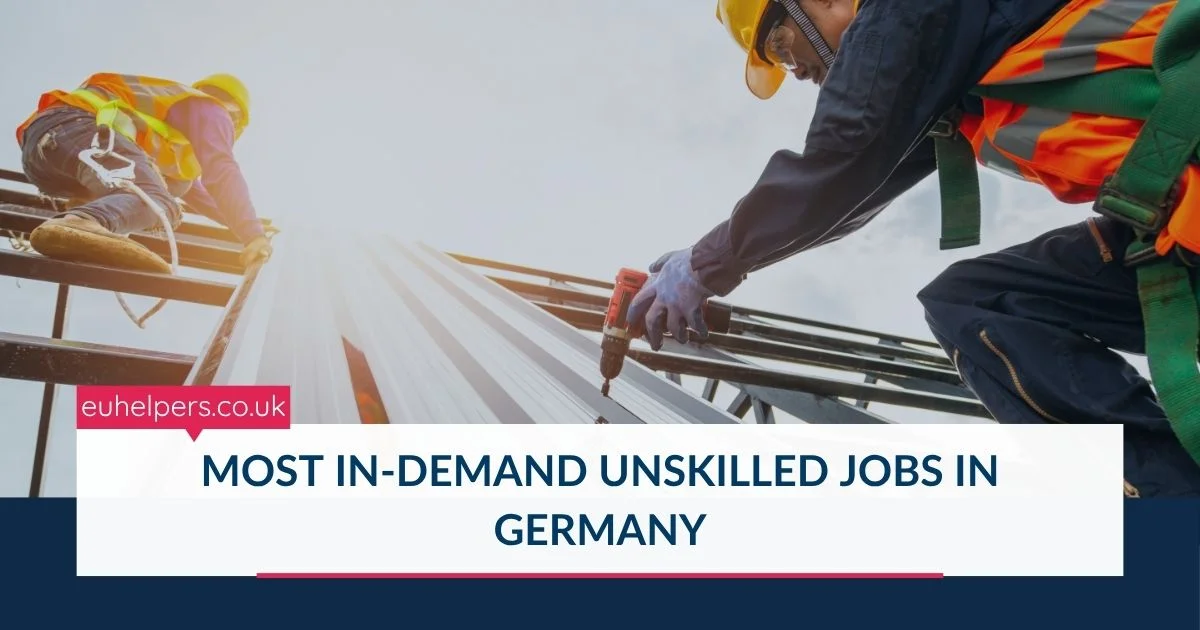
The current construction spurt in Germany has resulted in the demand of construction assistants, material handlers, demolition assistants, and site labourers.
Hourly wages: EUR10-EUR15 per hour. Salary: EUR1,600-EUR2,400 monthly with a significant amount of overtime in the peak seasons.
Construction is physically hard labor yet it has some of the highest unskilled wages. Germany has stringent safety standards and the employers are obligated to supply protective equipment and training.
Production and manufacturing.
There are positions required in the long manufacturing industry of Germany in assembly line workers, machine operators, quality control assistants and packaging staff.
Hourly wages: EUR9-EUR14 per hour. Monthly salary: EUR1,440-EUR2,240 full-time.
Manufacturing can provide the easiest job with defined shift patterns, benefits plans, and skills training that may eventually result in more remunerated specialty positions.
High Ranking Companies that will employ Foreigners in 2026.
By being aware of the list of employers who are aggressive sponsors of visas, the chances of success become many times higher. These firms have set up procedures of recruiting and retaining foreign employees:
- Logistics and Delivery: DHL, Amazon, Hermes, Deutsche Post, UPS, FedEx.
- Retail: Lidl, Aldi, Rewe, Edeka, Metro AG, Kaufland, Real.
- Hospitality: Large hotel chains (Marriott, Hilton, Accor), restaurant chains, catering agencies.
- Manufacturing: Volkswagen Group, Bosch, Siemens (their production plants), untold small and medium manufacturers.
- Facilities Management: ISS Facility Services, Dussmann Group, Wisag.
- Building: There are many local construction firms (city search).
Home Improvement OBI, Bauhaus, Hornbach (to work in the warehouse and retail positions)
Such businesses usually visit job fairs, recruitment agencies, and keep immigration support personnel to ease visa procedures of successful interns.
Application Process Step-by-step.
It takes a planned and systematic process to succeed and get a job without skills under the sponsorship of a visa. Here’s your roadmap:
Step 1: Select Your Visa Pathway.
Depending on your nationality, age, qualifications, and language skills, identify the visa route that best suits you. Nationals of Western Balkans are to pay attention to the Western Balkans Regulation. The under-25s who have employment opportunities ought to seek the under-25 employment visa. The others should aim at the Opportunity Card in case they can afford the points requirement.
Step 2: Begin German Language Learning Now.
This is what should be stressed: the knowledge of the German language is your most significant competitive advantage. Although it may not be mandatory in your visa path chosen (legal), employers are more than likely to choose candidates with at least a basic level of German.
Start learning with the help of such apps as Duolingo, Babbel, or Busuu. The minimum qualifications to be employed are A1 level and B1 level to get the best opportunities. Numerous German cultural centers (Goethe-Institut) provide affordable courses in the rest of the world.
Step 3: Prepare Your Documents
Prepare necessary papers long beforehand:
- Valid passport (at least 6 months of validity)
- Educational certificates (translation to German by certified translators)
- Work History and reference certificates.
- Passport-sized photos of German quality.
- Birth certificate and, where necessary, marriage certificate.
- Clearance certificate of the police in your home country.
- Evidence of financial capability (bank statement or having an account blocked)
- Health insurance records.
The average price of professional translation is EUR20-EUR50 per document. This is not a choice, everything should be in German or English.
Step 4: Finding Jobs in Legitimate Platforms.
Only use credible and official job sites to prevent scams:
Make-it-in-Germany.com: The official government site of Germany as a destination, as a worker.
Jobborse of Bundesagentur fur Arbeit (BA) The job board of Federal Employment Agency.
Indeed.de: Suitable warehousing and entry-level jobs.
StepStone.de: Giant job portal in Germany.
Monster.de: Monster is another large job board.
Company websites: Direct application to the big employers mentioned above.
Beware of any one who demands to be paid to get an employment. Genuine employers do not impose charges of employment opportunities. The visa sponsorship is not your responsibility but it is the responsibility of the employer.
Step 5: Develop a German-Style Resume (Lebenslauf)
The resume conventions in Germany are not the same as in other countries. Your Lebenslauf must contain a professional photo (this is a common practice in Germany), personal details (date of birth, nationality, contacts and address), education in a reverse chronological order, working experience with its specific responsibilities and achievements, language skills (indicate the level: A1, A2, B1, B2, C1, C2), and other certificates or licenses.
Limit it to not more than 2 pages, format it well and be sure of correct spelling and grammar. You may want to employ a professional translator to annotate your resume in the German language.
Step 6: Apply Strategically
You cannot merely spray your resume to hundreds of employers. Rather, apply to 20-30 jobs that are really a fit. Write a tailored cover letter (Anschriben) about each application in which you give the reasons why you are interested in that particular position and company.
After 1-2 weeks, follow up on applications and do not respond to applications without a reply. The German employers admire motivated candidates.
Step 7: Prepare for Interviews
The successful applications will result in the interview, which may take the form of a video call in the case of international applicants. Get to know the company, rehearse in responding to standard interview questions in German or English (whichever will be used in the interview) and have questions to ask the employer.
Be reliable, enthusiastic and show the desire to learn- these are the characteristics that German employers are extremely fond of. Do not lie about your level of mastering the German language; it will backfire when you claim to be fluent in it while you are not.
Step 8: Secure Your Job Offer
When an employer chooses to employ you, he or she will issue you a binding job offer letter (Arbeitsvertrag). This paper details your job, salary, date of employment and terms of employment. Read it thoroughly and clarify on what is not well understood.
Make sure that the employer confirms in the contract that he will sponsor your visa. There are employers who pay visa application fees; there are those who do not. Clarify this upfront.
Step 9: Apply for Your Visa
Having the job offer in your hands, make an appointment to the German embassy or consulate in your country. Caution: it may require 6+ months to make appointments in such high demand countries as India, Nigeria and Philippines. Make reservations in advance before getting a job offer.
Hand in all the necessary documents such as your filled visa application form, passport and photos, job offer letter of German employer, evidence of qualification (translated certificates), evidence of language proficiency (goethe institut certificate or other certified body), evidence of financial capability (blocked account confirmation), and health insurance coverage (initially travel insurance, afterwards German health insurance).
The visa application fees are around EUR75-EUR100 due to the type of visa. The processing normally requires 8-12 weeks, but can be longer.
Step 10: Prepare for Departure
After you have your visa, start to get down to practical preparations:
- Book your flight to Germany
- Find temporary housing within the first 2-4 weeks (hostels, Airbnb, or housing provided by employers)
- Open a German bank account (some banks such as N26 can be opened online in advance before arrival)
- Learn about your destination city.
- Bring clothes which suit German weather.
- Bring enough Euros to cover start-up costs (EUR1,000-EUR2,000 suggested)
Financial Reality: Expectations.
Speaking real numbers. Germany has much higher wages than most of the third world countries, yet it is more costly to live in Germany.
Initial Costs
You are not even there yet, estimate spending on visa application fees (EUR75-EUR100), document translation and certification (EUR200-EUR500), language course materials (EUR50-EUR200), blocked account deposit to Opportunity Card (EUR13,092 required), flights (EUR500-EUR1500 depending on origin) and initial accommodation deposits (EUR500-EUR1000).
Initial investment: between EUR2,000-EUR5,000, or between EUR14,000-EUR17,000 in case you require the blocked account in the case of Opportunity Card.
Monthly Living Costs
After you start working in Germany, your monthly bills will consist of:
- Accommodation: EUR300-EUR600 in a room in a shared flat (WG), in smaller cities; EUR500-EUR900 in larger cities such as Munich, Frankfurt or Hamburg. Plan your spending depending on where you are going.
- Food: EUR200-EUR350 based on whether you cook at home (far less expensive) or go out to dinners frequently.
- Health Insurance: Mandatory. Public health insurance costs around EUR110-EUR120 per month (you are half-paying, hence EUR55-EUR60 on your salary).
- Transport: EUR50-EUR100 per month on public transport (depending on the city).
- Phone and Internet: EUR20-EUR40 mobile phone plan; EUR30-EUR50 internet at home in case it is not included in the rent.
- Miscellaneous: EUR100-EUR200 on the clothing, personal, entertainment, etc.
- All-inclusive monthly costs: EUR770-EUR1,360 according to lifestyle and location.
Net Income After Taxes
The tax system in Germany is progressive, and at the lower-income job you will be taxed at an approximate of 70-75 percent of your gross salary and the income tax, health insurance, pension, and unemployment insurance will be payable, resulting in you having a net take-home pay of about 70-75 percent.
Assuming that you have a gross income of EUR2,000 per month (EUR14/hour on a full-time basis), your net income will be around EUR1,400-EUR1,500. This comfortably includes the basic living expenses in most of the German cities and will enable EUR200-EUR500 savings per month.
The more incomes have a lower percentage, although even the absolute amounts remain big. An individual with EUR2,500 gross income has a home salary of about EUR1,750-EUR1,850 net.
Health Insurance: Your Legal Requirement.
In Germany, health insurance is compulsory on the first day. Without it you cannot legally work and you will be required to provide evidence of insurance when you are registering your visa and residence permit.
Germany has two systems, namely, public (gesetzliche Krankenversicherung) and private (private Krankenversicherung). In the case of unskilled workers, the public insurance is the norm and even more cost effective.
Public health insurance will take about 14.6 percent of your gross income divided between you and your employer in equal measures. When one earns EUR2,000 a month, you are paying approximately EUR146 out of your salary and your employer is paying the same.
The public insurance includes doctor visits, stay at a hospital, prescription drugs (small co-pay), mental health services, pregnancy and delivery, rehabilitation, and preventive services.
Significant social insurance companies are TK (Techniker Krankenkasse), AOK, Barmer and DAK. They are all similar in terms of their coverage hence it is best to select one with the best reputation of customer service and convenience.
Purchase travel health insurance in an amount of at least EUR30,000 in medical costs before visiting Germany, at least until your German public insurance becomes effective.
How to avoid Scams: Red Flag warnings.
The influx of demand to the German jobs has created myriad fraudsters who prey on the desperate job seekers. Keep yourself safe by noting the following red flags:
Never pay for a job offer. The real employers do not require candidates to pay to get jobs or visa sponsorship. When anybody requests money in advance, it is a scheme.
Verify company legitimacy. Conducts research. Look on their official site, confirm that they are registered in the German commercial registers (Handelsregister) and find out reviews on other employees.
Distrust unrealistic promises. When one promises someone a visa or says they have some insider contacts in the embassies, he or she is lying. Visa is not given on grounds of affiliations but on the basis of fulfilling legal requirements.
Only use official platforms. It is necessary to apply via official websites found above rather than Facebook groups, WhatsApp offers, and agents who have approached you out of the blue.
Pay attention to bad communication. German employers who are legitimate address each other in a professional way with good grammar. The spelling mistakes and indistinct information in emails or the use of desperate urgence techniques are signs of scams.
Check embassy requirements in isolation. To be on the safe side, when booking a visa, visit the official German embassy site in your country. Fraudsters tend to give outdated or inaccurate data to mislead their victims.
When it does not feel right, follow your instinct. There are plenty of legitimate opportunities–you do not have to risk making deals with dubious propositions.
Germany: What to expect in life.
Other than the practical aspects of visas and work, think about what life in Germany will be like.
- Work Culture: Germans are punctual, reliable and communicate effectively. Be punctual, be attentive, and seek clarification when there is a need to. Workplaces are usually subordinate and polite. The work-life balance tends to be high, with the maximum of 48-hour workweek and the obligatory paid vacation (20 days a year and, in many cases, more).
- Language: Younger Germans tend to speak English, but they need to know German language on a daily basis. Most of the social interactions, government offices, and appointments made in health facilities are in German. Dedicate yourself to lifelong learning of the language.
- Weather: Germany is a four-season country. Winters are chilly (0-5degC) particularly in the southern areas. Spend money on winter clothing. Summers are mild to warm (20-30degC). In spring and autumn, it is lovely, but wet–never leave the umbrella at home.
- Bureaucracy: Germany is known by the bureaucratic processes. Register your home (Anmeldung) in the first 2 weeks of being in the country, get tax IDs, open bank accounts, and manoeuvre through government offices. It is very disappointing at first, but they get used to it over time.
- Social Life: Germans are reserved at first but they are friendly when you establish relationships with them. Participate in sports clubs (Verein) or language exchange clubs or international gatherings to expand your social circle. Your native immigrant communities can be of great help in the process of adjustment.
- Long-Term Prospects: You may request permanent residence (Niederlassungserlaubnis) after 5 years as a legally resident of Germany with a stable occupation. You can seek German citizenship after 8 years (or 6-7 years in case of good command in German language and integration) and this gives you dual citizenship with most countries since there have been recent reforms.
Your Future: Doing Things in 2026.
The shortage of workers in Germany is not an imaginary one, but an urgent one. The avenues are there, the employment opportunities are there and the salaries are competitive. What you need is preparation, persistence and realistic expectations.
Begin by evaluating what visa path suits you most. You need to start studying German today, even when you are only in the planning phase. Find research opportunities and target cities you like and can afford. Prepare the documents required and begin the translation process. Save on upfront expenses and establish a realistic schedule on how to go about your application.
This journey won’t be easy. Immigration never is. You will experience bureaucratic frustration, language barriers, adjusting to the culture, and doubtful times. But thousands of people, just like you manage to make this transition annually, creating new lives and getting access to opportunities that just were not available in their home countries.
In 2026, Germany requires employees of any level of skills. You are packing boxes in an Amazon warehouse, serving tables in a cafe in Berlin, or supporting the infrastructure of Germany on a construction site, you are creating one of the most successful economies in the world and at the same time creating your own life.
The door is open. The question is: Will you walk through it?
Take the first step today. Study your possibilities, begin to study the German language, and begin the application process. Your future is in Germany.
Thank you so much for reading. We will appreciate it if you share this with your loved ones.
Advertisements